Factorial designs and the split-plot trap
Today let's look at what happens when a study tests two things at once instead of one at a time, and why doing that well turns out to need more care than it looks.
Here is the example we will use throughout. A bakery wants to know what makes its cookies spread more on the tray: the oven temperature, Standard at 325F or High at 375F, and the recipe, the Original one or a New one with extra butter.
Temperature is awkward to test. Switching the oven from Standard to High and letting it settle again takes about 20 minutes, so a bakery cannot flip it before every single tray. Recipe is nothing like that. A baker can hand the New dough to one tray and the Original dough to the next tray in the very same oven run, with no waiting at all.
That gap, one factor cheap to change tray by tray and the other expensive to change at all, is already a hint that this design is going to need more care than a simple one.
Here is the design the bakery is going to run, before baking a single cookie.
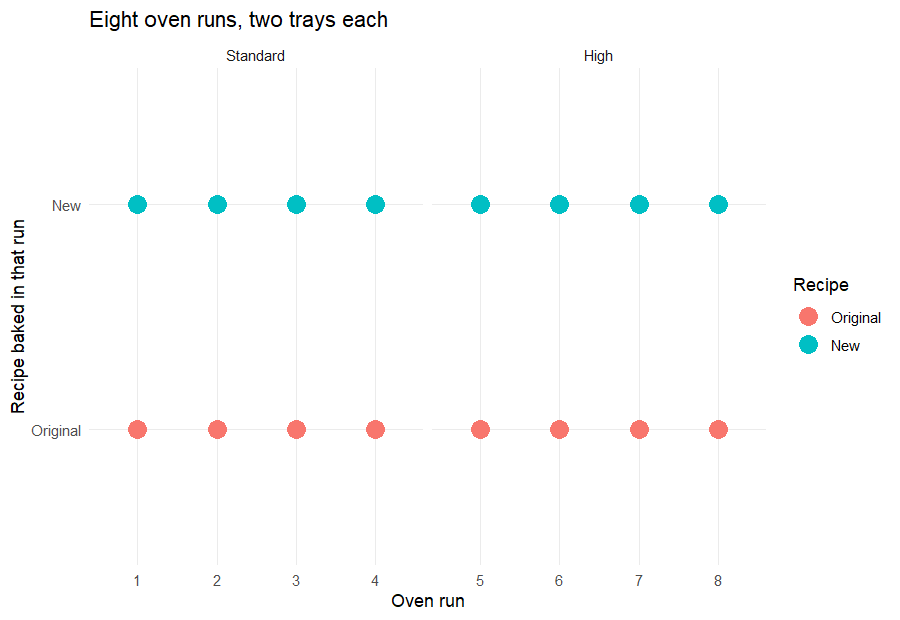
Eight oven runs, four at Standard and four at High, with one tray of each recipe baked inside every run.
Build that same design in R now, and reproduce this picture yourself.
Every tray in this design already carries one level of each factor, before a single cookie has even gone into the oven. That pairing, both factors crossed on the very same trays, is what makes testing them together worth more than testing them apart.
Why one factorial experiment beats two separate ones
Before looking at a single measured cookie, it's worth asking why the bakery would bother testing both factors at once instead of running two separate, simpler experiments.
Suppose the bakery settles on 4 replicate trays for every combination it tests. For the factorial design, that means 4 trays times the 2x2 = 4 combinations of temperature and recipe, 16 trays total.
Those same 16 trays still compare 8 High trays against 8 Standard trays for temperature's main effect, because every tray serves both factors at once: each of the 4 Standard-run trays carries Original or New, and so does each of the 4 High-run trays, for 8 trays on each side.
Now suppose the bakery tests the factors one at a time instead. Matching that same 8-versus-8 precision on temperature alone needs 16 trays. Matching it again on recipe alone, holding temperature fixed, needs another 16. Testing them apart costs 32 trays for the exact same precision on each factor that the factorial design got from 16.
That extra efficiency has a name, hidden replication. Every tray in the factorial design works for the temperature comparison and the recipe comparison at the same time, which is why 16 trays buy as much precision on each factor as 32 would buying them one at a time.
There is a second reason the one-factor-at-a-time test can never catch up, no matter how many trays it gets. It never bakes the New recipe at High temperature, so it can never tell whether temperature changes how much the New recipe spreads. That question needs both factors crossed in the same design. It is called an interaction.